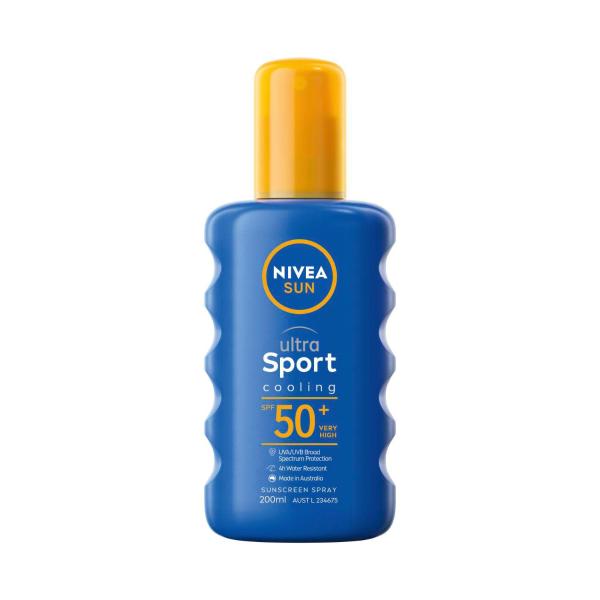
A formulation-based look at NIVEA’s Australian 200 mL pump-spray sunscreen, its five-filter system, cooling ingredients, skin-conditioning base and value.
FORMULA NOTES / SUNSCREEN
NIVEA Sun
Ultra Sport Cooling SPF50+
A closer look at its five UV filters, cooling ingredients and conditioning pump-spray lotion base.
A formulation-based review
Full disclosed ingredient inventory
homosalate, octyl salicylate, butyl methoxydibenzoylmethane, octocrylene, bemotrizinol, acrylates/c10-30 alkyl acrylate crosspolymer, alkyl (c12-15) benzoate, butylated hydroxytoluene, cetyl dimeticone, chlorphenesin, cocoglycerides, disodium edetate, dl-alpha-tocopheryl acetate, fragrance (perfume), glycerol, menthol, menthyl lactate, peg-15 cocamine, peg-40 stearate, phenoxyethanol, purified water, trolamine, white beeswax.
Source: TGA public summary for ARTG 234675, checked 31 October 2026. Five actives are listed first, followed by the 18 alphabetically listed excipients. This is a complete regulatory inventory, not a manufacturer-confirmed descending INCI list. Names retain TGA terminology in lowercase. Supporting ingredient concentrations are not disclosed; check the current pack for changes.
Coles, checked 31 October 2026
A cooling spray lotion with a five-filter system.
This Australian 200 mL pump-spray lotion combines five organic UV filters with glycerol, emollients and two cooling ingredients. The emphasis is practical body application for outdoor activity, with labelled four-hour water resistance. This profile covers AUST L 234675, not an overseas formula or a different NIVEA spray size. NIVEA Australia; TGA listing.
The spray format does not remove the need to apply generously and rub evenly. Filter count and summed percentages cannot predict the finished sunscreen’s protection.
Who might it suit?
- People who prefer a sprayable body lotion: the 200 mL bottle offers an alternative to squeezing a tube.
- Outdoor activity: the labelled water resistance is useful, provided reapplication instructions are followed.
- Those who enjoy a cooling sensation: menthol and menthyl lactate distinguish the sensory profile.
It is less appealing for someone specifically avoiding fragrance or cooling ingredients. The full TGA inventory includes perfume. Neither ethanol nor alcohol denat. is listed, but that does not establish universal tolerance. Test a small area first if skin is sensitive, as NIVEA advises. Manufacturer advice; Full ingredient inventory.
What do SPF50+ and broad spectrum mean?
SPF is a standardised measure of protection against UV-induced sunburn, weighted mainly toward UVB. Australian SPF50+ labelling requires a tested SPF of at least 60. It is not a safe time allowance in the sun. TGA SPF explanation.
The product is labelled broad spectrum for UVA and UVB protection. No numerical UVA-PF or PPD result is supplied in the sources reviewed, so none is assigned here. The ingredient schematic below is not a measurement of the finished sunscreen. Product claims; TGA guidance.
The UV filters and their disclosed percentages
| UV filter | % w/w | Main coverage | Role in the blend |
|---|---|---|---|
| UV filter: homosalate | % w/w: 10% | Main coverage: UVB | Role in the blend: UVB absorption within the multi-filter system. |
|
UV filter: octyl salicylate octisalate |
% w/w: 5% | Main coverage: UVB | Role in the blend: UVB absorption and solvent support for oil-soluble filters. |
|
UV filter: butyl methoxydibenzoylmethane avobenzone |
% w/w: 5% | Main coverage: UVA | Role in the blend: The dedicated UVA absorber. |
| UV filter: octocrylene | % w/w: 5% | Main coverage: Mainly UVB; some short UVA | Role in the blend: Complements UVB coverage and can support avobenzone photostability. |
| UV filter: bemotrizinol | % w/w: 0.3% | Main coverage: UVA & UVB | Role in the blend: Broad-spectrum absorption; performance depends on the whole blend. |

The disclosed strengths are 100, 50, 50, 50 and 3 mg/g respectively: 10%, 5%, 5%, 5% and 0.3% w/w. In particular, 3 mg/g bemotrizinol is not 3%. TGA public summary; NIVEA active ingredient disclosure.
Ingredient-spectrum references: homosalate, octisalate, avobenzone, octocrylene, bemotrizinol. Trade names identify reference ingredients, not confirmed suppliers for this product.
Ingredients grouped by function
Each of the 23 disclosed ingredients is assigned once by estimated primary role. Multifunctional ingredients may contribute in other ways; this is not access to the proprietary formula.
| Function | Ingredients | Role in formula |
|---|---|---|
| Function: UV filters | Ingredients: homosalate, octyl salicylate, butyl methoxydibenzoylmethane, octocrylene, bemotrizinol | Role in formula: Absorb UV across complementary wavelength regions. |
| Function: Emollients and conditioning | Ingredients: alkyl (c12-15) benzoate, cetyl dimeticone, cocoglycerides, white beeswax | Role in formula: Provide slip, soften skin and help structure the lotion; the ester also supports filter solubilisation. |
| Function: Humectant | Ingredients: glycerol | Role in formula: Helps bind water in the formula and outer skin layers. |
| Function: Cooling ingredients | Ingredients: menthol, menthyl lactate | Role in formula: Provide a cooling sensation; this is separate from UV protection. |
| Function: Antioxidant support | Ingredients: butylated hydroxytoluene, dl-alpha-tocopheryl acetate | Role in formula: Formula antioxidant and vitamin E derivative; not additional UV filters. |
| Function: Emulsifiers | Ingredients: peg-15 cocamine, peg-40 stearate | Role in formula: Help keep oil and water components dispersed. |
| Function: Texture modifier | Ingredients: acrylates/c10-30 alkyl acrylate crosspolymer | Role in formula: Helps control viscosity and lotion structure. |
| Function: Preservation | Ingredients: chlorphenesin, phenoxyethanol | Role in formula: Help protect the formula from microbial contamination. |
| Function: Chelating agent | Ingredients: disodium edetate | Role in formula: Binds metal ions to support formula stability. |
| Function: pH adjustment | Ingredients: trolamine | Role in formula: Helps set pH and neutralise the polymer system. |
| Function: Fragrance | Ingredients: fragrance (perfume) | Role in formula: Provides scent; relevant for people avoiding fragrance. |
| Function: Solvent | Ingredients: purified water | Role in formula: The aqueous carrier. |
The key ingredients, explained
| Ingredient | What it contributes |
|---|---|
| Ingredient: avobenzone + bemotrizinol | What it contributes: UVA absorption within a complementary five-filter blend. This does not disclose a numerical UVA-PF. |
| Ingredient: homosalate + octisalate + octocrylene | What it contributes: Predominantly UVB support; the whole system is tested as a finished sunscreen. |
| Ingredient: glycerol | What it contributes: A humectant that gives the lotion a hydration-supporting component. |
| Ingredient: alkyl (c12-15) benzoate + cocoglycerides + cetyl dimeticone | What it contributes: Emollient and spreading support, helping distribute the oily phase and condition skin. |
| Ingredient: menthol + menthyl lactate | What it contributes: Cooling sensory ingredients, not extra sun protection or treatment for sunburn. |
| Ingredient: dl-alpha-tocopheryl acetate | What it contributes: A vitamin E derivative used for conditioning; its concentration and independent benefit here are not disclosed. |
The protective film matters as much as the filter list.
This is a water-containing emulsion delivered through a spray head, rather than simply a list of filters in a volatile alcohol carrier. Emollients, emulsifiers, beeswax and a polymer help organise its texture and spreading behaviour. Glycerol adds water-binding support.
Those ingredients give a plausible formulation rationale, but they do not let us reconstruct the film or predict water resistance. The cooling sensation comes from sensory ingredients; feeling cooler does not mean receiving less UV. A visibly even layer and adequate application remain essential.
Reading the claims carefully
- Four-hour water resistance: a labelled performance claim, not permission to wait four hours before reapplying.
- Fast absorbing, non-greasy and non-sticky: manufacturer sensory claims; actual feel varies with dose and wearer.
- Cooling: a sensory feature, not a separate protection factor.
- Visible-light effects: NIVEA also refers to protection against High Energy Visible Light effects. No numerical product-specific visible-light attenuation result was supplied in the reviewed sources; this should not be treated as proven visible-light shielding or a melasma-specific claim.
- Wet skin: no explicit permission to apply to already-wet skin was located. Water resistance and wet-skin application are different claims.
Directions and cautions
Shake well. Hold the bottle 10–15 cm from the body and spray generously and evenly until the skin looks and feels wet with product, then rub evenly. This instruction describes adequate product coverage, not application to already-wet skin. Apply 20 minutes before sun exposure. Reapply every two hours, or more often after sweating, swimming or towelling. NIVEA directions.
Do not spray directly onto the face. Spray into hands first, then apply. Avoid inhalation, use in a well-ventilated area and avoid windy conditions. Avoid eyes and broken, damaged or diseased skin. Test a small area first on sensitive skin and stop use if irritation occurs. Allow to dry before dressing; contact can stain fabrics or surfaces. Store below 30°C and check the current pack’s expiry.
Use clothing, a hat, sunglasses and shade as well as sunscreen, and avoid prolonged exposure and intense midday sun. Cancer Council recommends approximately 35 mL for an average adult’s full-body application. A spray format is not a reason to use less, and no reliable number of pumps per application is disclosed here. Cancer Council application guidance.
What published sunscreen research tells us
Consistent use matters for photoageing.
An Australian randomised study followed 903 adults younger than 55 for 4.5 years. Daily sunscreen use was associated with 24% lower relative odds of increased skin ageing than discretionary use. This supports regular protection; it did not test this NIVEA formula. Hughes and colleagues, 2013.
The dose matters as well as the format.
Generous, even application and timely reapplication are more useful than choosing by filter count. The best sensory format is one you can use adequately and consistently. Cancer Council advice.
Our assessment
NIVEA Ultra Sport Cooling offers a clearly disclosed five-filter system in a practical pump-spray lotion. Glycerol and the emollient base provide useful hydration and skin-conditioning support, while the cooling ingredients make its sensory positioning distinctive. The key trade-off is that perfume and cooling agents may not suit people seeking a fragrance-free, minimal-sensation sunscreen.
At the checked Coles price of A$23.50 for 200 mL, it costs A$11.75 per 100 mL, or approximately A$1.18 per 10 mL. That is a straightforward way to budget for generous body application. This is a retailer price snapshot, not a comparative value rating; availability and price can vary by location. Coles price source, checked 31 October 2026.
Its practical value depends on whether the spray lotion makes adequate application easier for you. Rub it in, follow the inhalation precautions and keep to two-hourly reapplication and reapplication after water, sweat or towelling. Do not treat cooling or four-hour water resistance as permission to remain in the sun longer, or as a wet-skin application claim.
Further reading
Products for Dry & Dehydrated Skin
-
Regular price$79.00 AUDRegular price
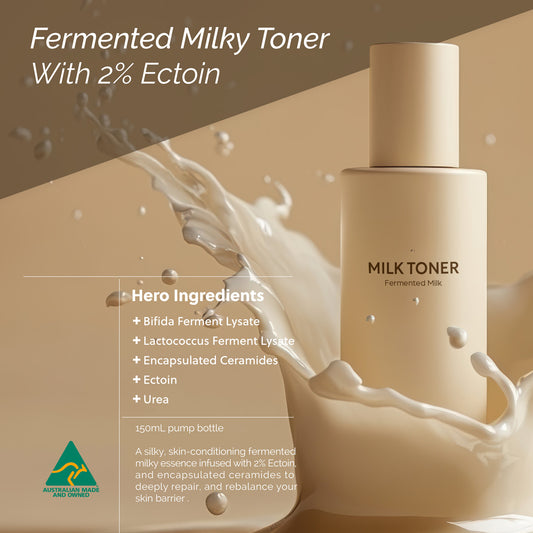
$0.00 AUDSale price$79.00 AUD Save $-79.00 AUD (%)Unit priceperFermented Milky Toner
-
Regular price$59.00 AUDRegular priceSale price$59.00 AUD Save $-59.00 AUD (%)Unit priceper
Daily Face Hydrator
-
Regular price$36.00 AUDRegular priceSale price$36.00 AUD Save $-36.00 AUD (%)Unit priceper
Gel Cleanser
-
Regular price$55.00 AUDRegular priceSale price$55.00 AUD Save $-55.00 AUD (%)Unit priceper
Milk Cleanser
-
Regular price$69.00 AUDRegular priceSale price$69.00 AUD Save $-69.00 AUD (%)Unit priceper
Water Bomb Face Cream
-
Regular price$39.00 AUDRegular priceSale price$39.00 AUD Save $-39.00 AUD (%)Unit priceper
Green Envy AHA Serum