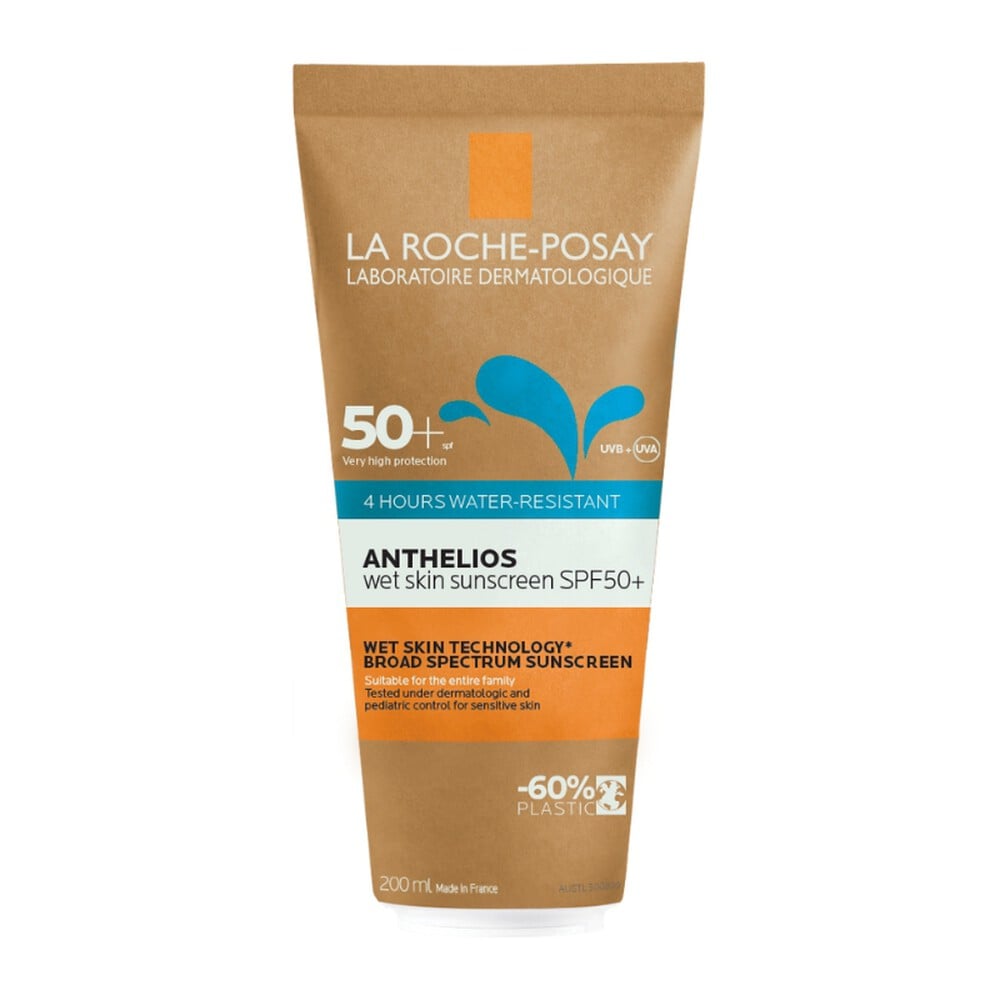
A formulation-based look at the Australian Anthelios Wet Skin SPF50+, its six-filter system, water-resistant film, hydration support and price per 100 mL.
FORMULA NOTES / SUNSCREEN
La Roche-Posay
Anthelios Wet Skin SPF50+
A closer look at its six-filter system, wet-skin application and the formula supporting everyday face and body protection.
A formulation-based review
Full disclosed ingredient inventory
Active ingredients: homosalate 10% w/w, drometrizole trisiloxane 5% w/w, octyl salicylate 5% w/w, bemotrizinol 4.5% w/w, ethylhexyl triazone 4.5% w/w, butyl methoxydibenzoylmethane 3.5% w/w. Other ingredients (TGA names): acrylates/dimethicone copolymer, ascorbyl palmitate, carbomer 980, dicaprylyl ether, dimeticone 5, disodium edetate, dl-alpha-tocopherol, ethanol, glycerol, glyceryl monooleate, hydrogenated palm glycerides citrate, isohexadecane, lecithin, nylon-12, p-anisic acid, peg-8 laurate, phenoxyethanol, propanediol, purified water, styrene/acrylates copolymer, trolamine.
Source: TGA public summary for ARTG 300899 and Australian product information, checked 31 October 2026. This regulatory inventory contains six actives and 21 excipients. The excipients are alphabetically listed, not in descending concentration. The manufacturer separately discloses ethanol at 3% v/v. This is not an ordered cosmetic INCI declaration; match your current pack before use.
Official Australian price, checked 31 October 2026
A wet-skin sunscreen built around a six-filter system.
Anthelios Wet Skin is a face-and-body sunscreen designed to remain practical around water. Its distinguishing feature is the manufacturer’s claim of four-hour water resistance even when applied to wet skin. This review covers the Australian 200 mL product associated with AUST L 300899. Australian product information; TGA entry.
The disclosed blend combines UVB filters with avobenzone, bemotrizinol and drometrizole trisiloxane for broader UV coverage. It is not the UVMune 400 formula: drometrizole trisiloxane is commonly known as Mexoryl XL, and should not be confused with Mexoryl 400.
Who might it suit?
- Face and body use around water: someone who values a product designed for application to wet skin as well as dry skin.
- A family-sized tube: someone wanting a 200 mL format rather than a small face-only sunscreen.
- A lotion with hydration and emollient support: glycerol and propanediol sit alongside spreading agents, silicones and film-forming polymers.
No fragrance is listed in the TGA inventory, but the formula does contain ethanol, disclosed at 3% v/v. The brand positions it for sensitive skin and children; individual tolerance, especially around eyes or on irritated skin, still varies. Follow the current pack’s age and use directions rather than interpreting family positioning as suitability for every infant.
What do SPF50+ and broad spectrum mean?
SPF primarily describes protection against UV-induced sunburn under test conditions. Australian SPF50+ labelling requires a test result of at least SPF60; it is not permission to stay outside indefinitely. TGA explanation of SPF testing.
Broad-spectrum labelling addresses UVA as well as UVB. A product-specific measured UVA-PF or PPD was not located in the sources reviewed, so none is assigned here. Nor does SPF50+ establish protection against visible light or infrared. TGA sunscreen guidance.
The UV filters and their disclosed percentages
| UV filter | % w/w | Main coverage | Role in the blend |
|---|---|---|---|
| UV filter: homosalate | % w/w: 10% | Main coverage: UVB | Role in the blend: Adds UVB absorption and supports oil-phase filter formulation. |
|
UV filter: drometrizole trisiloxane Mexoryl XL |
% w/w: 5% | Main coverage: UVA & UVB | Role in the blend: A broad-spectrum absorber with peaks in both UVB and UVA. |
|
UV filter: octyl salicylate Octisalate; INCI: ethylhexyl salicylate |
% w/w: 5% | Main coverage: UVB | Role in the blend: Adds UVB absorption and solvent support for oil-soluble filters. |
|
UV filter: bemotrizinol INCI: bis-ethylhexyloxyphenol methoxyphenyl triazine |
% w/w: 4.5% | Main coverage: UVA & UVB | Role in the blend: A photostable broad-spectrum absorber that complements the blend. |
| UV filter: ethylhexyl triazone | % w/w: 4.5% | Main coverage: UVB | Role in the blend: An efficient UVB absorber. |
|
UV filter: butyl methoxydibenzoylmethane Avobenzone |
% w/w: 3.5% | Main coverage: UVA | Role in the blend: A dedicated UVA absorber; the surrounding formulation matters for stability. |

The manufacturer’s percentages agree with the TGA quantities in mg/g. Filter totals cannot be added to calculate SPF. Manufacturer disclosure; TGA public summary.
Ingredient and spectral references: homosalate, octisalate, avobenzone, bemotrizinol, ethylhexyl triazone, and drometrizole trisiloxane peaks, patent paragraph 0060. Trade names help identify ingredients; they do not confirm this product’s suppliers.
Ingredients grouped by function
Ingredients are grouped once by estimated primary formulation role. Some have more than one function; this is not access to the exact formula.
| Function | Ingredients | Role in formula |
|---|---|---|
| Function: UV filters | Ingredients: homosalate, drometrizole trisiloxane, octyl salicylate, bemotrizinol, ethylhexyl triazone, butyl methoxydibenzoylmethane | Role in formula: Absorb UV radiation within the finished sunscreen film. |
| Function: Humectants | Ingredients: glycerol, propanediol | Role in formula: Support water binding and skin comfort. |
| Function: Other emollients | Ingredients: dicaprylyl ether, dimeticone 5, isohexadecane | Role in formula: Support spreading, slip and a conditioned feel. |
| Function: Emulsifiers and lipid support | Ingredients: glyceryl monooleate, lecithin, peg-8 laurate | Role in formula: Help organise the oil and water phases; some also contribute emollience. |
| Function: Film-forming polymers | Ingredients: acrylates/dimethicone copolymer, styrene/acrylates copolymer | Role in formula: Contribute to the film and wear characteristics. Presence alone does not establish water resistance. |
| Function: Texture modifiers | Ingredients: carbomer 980, nylon-12 | Role in formula: Help control viscosity and texture. |
| Function: Antioxidant and conditioning ingredients | Ingredients: ascorbyl palmitate, dl-alpha-tocopherol, hydrogenated palm glycerides citrate | Role in formula: Support the formulation and skin-conditioning system; they are not additional UV-filter percentages. |
| Function: Preservatives and support | Ingredients: phenoxyethanol, p-anisic acid | Role in formula: Contribute to preservation and formula protection. |
| Function: Chelating agent | Ingredients: disodium edetate | Role in formula: Binds metal ions to support stability. |
| Function: pH adjuster | Ingredients: trolamine | Role in formula: Adjusts pH and can neutralise the thickening polymer. |
| Function: Solvents | Ingredients: purified water, ethanol | Role in formula: Provide the carrier and solvent system; ethanol is separately disclosed at 3% v/v. |
All six actives and 21 excipients in the TGA inventory are accounted for. Regulatory names are retained in lowercase for traceability: glycerol is glycerin, dimeticone refers to dimethicone, and dl-alpha-tocopherol is vitamin E. Except for the separately disclosed ethanol amount, excipient concentrations are not supplied.
The key ingredients, explained
| Ingredient | What it contributes |
|---|---|
| Ingredient: avobenzone + bemotrizinol + drometrizole trisiloxane | What it contributes: The UVA-facing part of the system, with the latter two also absorbing UVB. |
| Ingredient: homosalate + octisalate + ethylhexyl triazone | What it contributes: Complementary UVB absorption. |
| Ingredient: glycerol + propanediol | What it contributes: Humectant support alongside the sunscreen function. |
| Ingredient: dicaprylyl ether + dimethicone + isohexadecane | What it contributes: Spreading and emollient support, relevant to how a sunscreen feels when applied generously. |
| Ingredient: acrylates/dimethicone + styrene/acrylates copolymers | What it contributes: Film-forming ingredients consistent with a wear-focused formula. The complete Wet Skin Technology recipe is not disclosed. |
| Ingredient: tocopherol + ascorbyl palmitate | What it contributes: Vitamin E and a vitamin C derivative. Their presence does not make this a dedicated vitamin C treatment or establish measured infrared protection. |
| Ingredient: ethanol | What it contributes: Disclosed at 3% v/v. It is a solvent and a tolerance consideration, not evidence that the whole formula is necessarily drying. |
The protective film matters as much as the filter list.
The wet-skin feature is the formulation’s clearest point of difference. The brand describes a hydrophobic film, and the disclosed polymers, emollients and silicones are consistent with a film-forming design. That is a formulation rationale, not a reconstruction of the proprietary technology or an independent test of wear.
The water-binding ingredients balance that emphasis with hydration support. The mixture also includes vitamin E and ascorbyl palmitate, but their undisclosed amounts do not justify a separate antioxidant-treatment rating. Protection still depends on applying enough product evenly and maintaining the film through reapplication.
Reading the claims carefully
- Wet-skin application: the manufacturer states that four-hour water resistance is maintained when applied to wet skin. This does not remove the instruction to apply before exposure.
- Four-hour water resistance: a labelled test claim, not a four-hour reapplication interval.
- Sensitive-skin, non-comedogenic and non-eye-stinging claims: manufacturer claims rather than guarantees for every wearer. The TGA record still instructs avoiding eye contact.
- XL-Protect and infrared/pollution language: these are brand descriptions. No product-specific infrared transmission or clinical pollution-protection result is assigned here.
- Mexoryl XL: drometrizole trisiloxane, not the Mexoryl 400 filter used in some UVMune products.
Directions and cautions
Apply generously and evenly 20 minutes before sun exposure. Reapply at least every two hours and after swimming, towelling or perspiring. Follow the pack even when applying to wet skin. Use protective clothing, a broad-brimmed hat, sunglasses and shade, and avoid prolonged sun exposure. Manufacturer directions.
For an average adult, Cancer Council recommends roughly 35 mL for full-body coverage: about a teaspoon for each arm, each leg, front of body, back of body, and face, neck and ears. A small pearl-sized amount is not an adequate whole-body dosing guide. Cancer Council application advice.
Avoid eye contact. Keep babies and young children out of direct sunlight; use the current pack’s age guidance and seek advice before use on very young babies. Stop use if irritation develops. Check the pack for expiry, storage and any updated warnings. TGA warnings; Australian product directions.
What published sunscreen research tells us
Consistent use matters for photoageing.
In a randomised Australian study of 903 adults younger than 55, daily sunscreen use was associated with 24% lower relative odds of increased skin ageing over 4.5 years than discretionary use. This supports regular sunscreen use as a habit; it was not a trial of this Anthelios formula. Hughes and colleagues, 2013.
Comfort matters when it supports adequate application.
A sunscreen’s texture and application format are practical considerations because protection depends on using enough and reapplying. Wet-skin compatibility can be convenient around swimming, but it should not be interpreted as permission to apply less or skip reapplication. Cancer Council sunscreen advice.
Our assessment
Anthelios Wet Skin has a clear formulation purpose: broad-spectrum SPF50+ in a face-and-body format that can be applied to wet skin. Its six-filter blend includes three ingredients with UVA absorption, while glycerol, propanediol and emollients add a useful comfort-focused base. The film-forming system is a more meaningful differentiator than simply counting filters.
At the official Australian price of A$47.99 for 200 mL, it costs approximately A$24.00 per 100 mL, or A$2.40 per 10 mL. The 200 mL format offers more product than a small facial sunscreen, but repeated full-body application can still use it quickly. Its value rests on whether the wet-skin feature and wearing comfort make generous, regular use easier for you. This is not a comparative value score, and prices may change.
No fragrance appears in the regulatory inventory, while ethanol is disclosed at 3% v/v. Those details are useful for choosing a formula, but cannot predict every person’s tolerance. The main practical caveat is unchanged: four-hour water resistance does not replace two-hourly reapplication or reapplication after swimming, sweating and towelling.
Further reading
- La Roche-Posay Australia: Anthelios Wet Skin SPF50+
- TGA: ARTG 300899
- TGA: full public summary and ingredient inventory
- TGA: choosing sunscreen
- TGA: SPF testing information
- Cancer Council: choosing, applying and storing sunscreen
- Hughes et al. Sunscreen and prevention of skin aging, 2013
- European Patent Office: drometrizole trisiloxane spectral peaks
Products for Dry & Dehydrated Skin
-
Regular price$79.00 AUDRegular price
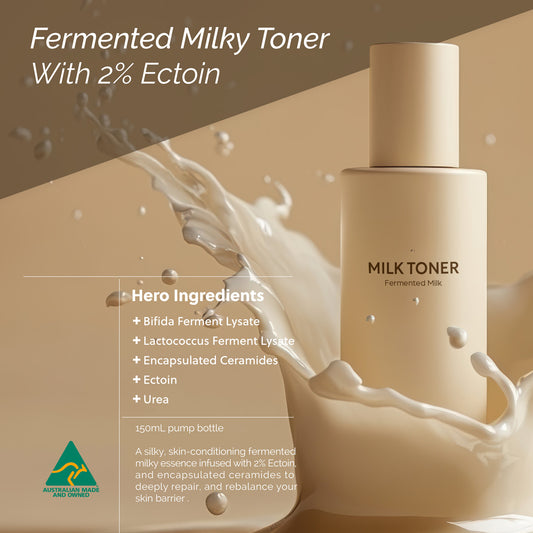
$0.00 AUDSale price$79.00 AUD Save $-79.00 AUD (%)Unit priceperFermented Milky Toner
-
Regular price$59.00 AUDRegular priceSale price$59.00 AUD Save $-59.00 AUD (%)Unit priceper
Daily Face Hydrator
-
Regular price$36.00 AUDRegular priceSale price$36.00 AUD Save $-36.00 AUD (%)Unit priceper
Gel Cleanser
-
Regular price$55.00 AUDRegular priceSale price$55.00 AUD Save $-55.00 AUD (%)Unit priceper
Milk Cleanser
-
Regular price$69.00 AUDRegular priceSale price$69.00 AUD Save $-69.00 AUD (%)Unit priceper
Water Bomb Face Cream
-
Regular price$39.00 AUDRegular priceSale price$39.00 AUD Save $-39.00 AUD (%)Unit priceper
Green Envy AHA Serum