A formulation-based look at Bioderma’s Australian face-and-body sunscreen, its four-filter system, conditioning base, wet-skin claims and cost per 100 mL.
FORMULA NOTES / SUNSCREEN
Bioderma
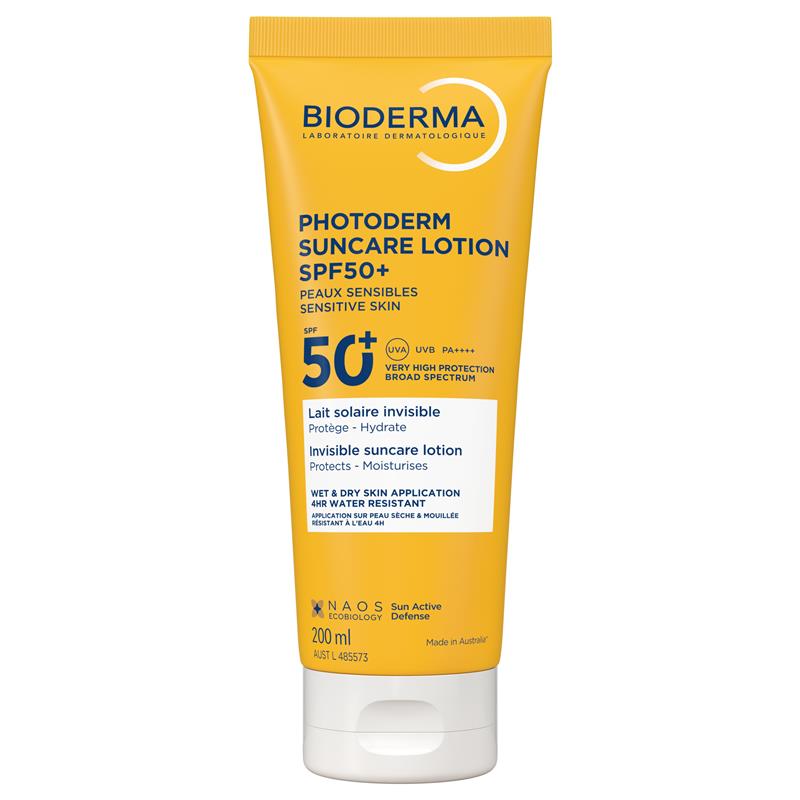
Photoderm Suncare Lotion SPF50+
A closer look at its four UV filters, wet-skin application and emollient, ectoin-containing base.
A formulation-based review
Full ingredient list
aqua, propylene glycol dicaprylate/dicaprate, butylene glycol dicaprylate/dicaprate, octocrylene, ethylhexyl salicylate, butyl methoxydibenzoylmethane, dibutyl adipate, ethylhexyl triazone, trimethylpentanediol/adipic acid/glycerin crosspolymer, cetyl alcohol, potassium cetyl phosphate, dimethicone, phenoxyethanol, hydroxyacetophenone, benzyl alcohol, polyglyceryl-3 diisostearate, silica, aloe barbadensis leaf juice, acrylates/c10-30 alkyl acrylate crosspolymer, xanthan gum, disodium edta, tocopheryl acetate, ectoin, ethylhexylglycerin, mannitol, sodium hydroxide, citric acid.
Source: Bioderma Australia’s full ingredient list, checked 31 October 2026. The manufacturer’s displayed sequence is preserved, with its parenthetical INCI equivalents used where given and names in lowercase. TGA public summary for ARTG 485573 confirms four actives and 23 excipients; its separate excipient list is alphabetical, not concentration order. Supporting ingredient percentages are undisclosed. Check the current pack for any changes.
Chemist Warehouse, checked 31 October 2026
A wet-skin sunscreen with a conditioning base.
This Australian Photoderm Suncare Lotion combines four organic UV filters with an emollient-rich vehicle, ectoin and mannitol. Its practical appeal is a fragrance-free face-and-body format with an explicit wet- or dry-skin application claim. This review covers AUST L 485573, not an overseas Photoderm lotion or the Australian Suncare Fluid or Serum. Australian product information; TGA entry.
The filter system and the supporting base should be read together: the actives absorb UV, while solvents, emulsifiers and polymers help distribute them in a usable lotion. Counting filters or adding their percentages cannot predict the finished product’s SPF.
Who might it suit?
- Adults seeking one face-and-body lotion: a 200 mL tube gives room for generous application.
- People applying sunscreen around swimming: the brand explicitly permits application to wet as well as dry skin.
- Those preferring fragrance-free formulas: no parfum is listed, and the brand describes it as fragrance-free.
Important suitability limit: Bioderma advises adults only and does not recommend this product for body use during pregnancy or breastfeeding. Follow that product-specific warning rather than treating it as a general statement about all sunscreens. Manufacturer directions and warnings.
The list includes cetyl alcohol, a fatty alcohol, and benzyl alcohol in the preservation system. Neither should be confused with ethanol or alcohol denat., which are not listed. Fragrance-free still does not guarantee tolerance around the eyes or on reactive skin.
What do SPF50+ and broad spectrum mean?
SPF describes protection against UV-induced sunburn under standardised testing and is weighted mainly toward UVB. Australian SPF50+ labelling requires a test result of at least SPF60. It is not a measure of how long someone can safely remain outdoors. TGA SPF explanation.
The product is labelled broad spectrum and the brand also reports PA++++. That is a UVA-protection category, not a disclosed exact UVA-PF or PPD result. No numerical product-specific UVA-PF is assigned here. These UV claims do not establish visible-light protection. Product claims; TGA guidance.
The UV filters and their disclosed percentages
| UV filter | % w/w | Main coverage | Role in the blend |
|---|---|---|---|
| UV filter: octocrylene | % w/w: 5% | Main coverage: Primarily UVB | Role in the blend: Absorbs UVB and contributes to the filter system’s photostability. |
|
UV filter: octyl salicylate octisalate; INCI: ethylhexyl salicylate |
% w/w: 4.5% | Main coverage: UVB | Role in the blend: Adds UVB absorption and solvent support for oil-soluble filters. |
|
UV filter: butyl methoxydibenzoylmethane avobenzone |
% w/w: 3% | Main coverage: UVA | Role in the blend: The dedicated UVA absorber in this disclosed blend; its surrounding formulation matters for stability. |
| UV filter: ethylhexyl triazone | % w/w: 3% | Main coverage: UVB | Role in the blend: An efficient UVB absorber that complements the other filters. |

The label quantities of 50, 45, 30 and 30 mg/g convert to 5%, 4.5%, 3% and 3% w/w respectively. They agree with the current TGA record. TGA public summary; Manufacturer disclosure.
Ingredient references: octocrylene, octisalate, avobenzone, and ethylhexyl triazone. Trade names identify reference ingredients, not confirmed suppliers for this lotion.
Ingredients grouped by function
Each ingredient is assigned once by estimated primary formulation role. Some have several functions; this classification is not access to the exact formula.
| Function | Ingredients | Role in formula |
|---|---|---|
| Function: UV filters | Ingredients: octocrylene, ethylhexyl salicylate, butyl methoxydibenzoylmethane, ethylhexyl triazone | Role in formula: Absorb UV as part of the finished sunscreen film. |
| Function: Other emollients | Ingredients: propylene glycol dicaprylate/dicaprate, butylene glycol dicaprylate/dicaprate, dibutyl adipate, cetyl alcohol, dimethicone | Role in formula: Provide slip and skin conditioning; ester solvents also support oil-soluble filters. |
| Function: Hydration and osmolyte support | Ingredients: ectoin, mannitol | Role in formula: Water-binding and protective-solute support. Their concentrations are not disclosed. |
| Function: Botanical ingredients | Ingredients: aloe barbadensis leaf juice | Role in formula: A supporting botanical ingredient; its dose and a specific soothing effect are not established. |
| Function: Antioxidant and conditioning ingredients | Ingredients: tocopheryl acetate | Role in formula: A vitamin E derivative used for skin conditioning; it is not an additional UV filter. |
| Function: Emulsifiers | Ingredients: potassium cetyl phosphate, polyglyceryl-3 diisostearate | Role in formula: Help stabilise the water and oil phases. |
| Function: Film and texture modifiers | Ingredients: trimethylpentanediol/adipic acid/glycerin crosspolymer, silica, acrylates/c10-30 alkyl acrylate crosspolymer, xanthan gum | Role in formula: Help organise the film, viscosity and finish. Their presence alone does not prove wet-skin performance. |
| Function: Preservation and support | Ingredients: phenoxyethanol, hydroxyacetophenone, benzyl alcohol, ethylhexylglycerin | Role in formula: Support microbiological protection of the formula; some have additional solvent or conditioning roles. |
| Function: Chelating agent | Ingredients: disodium edta | Role in formula: Binds metal ions to support formula stability. |
| Function: pH adjusters | Ingredients: sodium hydroxide, citric acid | Role in formula: Help set the formulation’s pH. |
| Function: Solvent | Ingredients: aqua | Role in formula: The aqueous carrier. |
All 27 ingredients are accounted for. Propylene glycol dicaprylate/dicaprate and butylene glycol dicaprylate/dicaprate are ester emollients, not the free glycols. The glycerin named within the crosspolymer is not evidence of separately added free glycerin.
The key ingredients, explained
| Ingredient | What it contributes |
|---|---|
| Ingredient: avobenzone | What it contributes: The principal UVA absorber in this four-filter system. |
| Ingredient: octocrylene + octisalate + ethylhexyl triazone | What it contributes: Complementary UVB absorption and support for the overall UV system. |
| Ingredient: ectoin + mannitol | What it contributes: The supporting pair highlighted in the brand’s SUN ACTIVE DEFENSE technology. Their presence does not reveal the dose or establish independent clinical outcomes for this product. |
| Ingredient: ester emollients + dimethicone + cetyl alcohol | What it contributes: A conditioning base that can make generous application more comfortable. Finish still needs to be judged on skin. |
| Ingredient: polymer and emulsifier system | What it contributes: A plausible structural basis for spreading and film formation, without reconstructing the proprietary wet-skin technology. |
| Ingredient: tocopheryl acetate + aloe | What it contributes: Supporting conditioning ingredients rather than substitutes for the labelled UV filters. |
The protective film matters as much as the filter list.
The useful formulation story is the combination of UV filters with a substantial emollient and film-forming base. Several ester ingredients can assist filter solubilisation and spread, while emulsifiers, fatty alcohol and polymers help give the lotion structure.
Ectoin and mannitol add hydration-focused support. The ingredient list cannot tell us their concentrations or how much they contribute to the finished sunscreen’s measured performance. The wet-skin claim is supported by the manufacturer’s product testing, rather than being something we can infer from the ingredient list alone.
Reading the claims carefully
- Wet-skin application: the brand cites water-dispersibility testing and an in-vivo evaluation on wet skin; the full reports are data on file rather than published here.
- Four-hour water resistance: the brand references in-vivo testing under AS/NZS 2604. This is not a four-hour reapplication interval.
- SUN ACTIVE DEFENSE: a manufacturer technology claim built around supporting ingredients and proprietary testing. It is not a separate SPF value or a substitute for adequate application.
- Comfort and non-comedogenicity: brand-supported claims from relatively small studies, not guarantees for every wearer. Eye contact should still be avoided.
Directions and cautions
Apply generously to face and body 20 minutes before sun exposure, as the last skincare step before makeup. Reapply at least every two hours and immediately after swimming, exercise or towelling, including when using the wet-skin feature. Combine sunscreen with shade, clothing, a broad-brimmed hat and sunglasses. Manufacturer directions.
For an average adult’s full-body application, Cancer Council recommends around 35 mL, approximately a teaspoon for each arm, each leg, the front and back of the body, and the face, neck and ears. Cancer Council application guidance.
For adults only. The manufacturer does not recommend body use during pregnancy or breastfeeding. This is the stated restriction for this product; it does not establish that every use or every sunscreen carries the same risk. If that applies to you, ask a pharmacist or clinician about an appropriate alternative. Avoid eyes and broken, damaged or diseased skin. Use externally, stop if irritation occurs, and check the current pack’s expiry and storage instructions. Product warnings.
What published sunscreen research tells us
Consistent use matters for photoageing.
A randomised Australian study followed 903 adults younger than 55 for 4.5 years. Daily sunscreen use was associated with 24% lower relative odds of increased skin ageing than discretionary use. This supports the habit of regular protection; it was not a test of this Bioderma formula. Hughes and colleagues, 2013.
Application is part of the result.
Using enough sunscreen and renewing the layer are practical determinants of protection. A comfortable lotion and wet-skin compatibility may make that routine easier, but neither permits under-application or skipped reapplication. Cancer Council advice.
Our assessment
Photoderm Suncare Lotion has a coherent face-and-body design: a disclosed four-filter system, a fragrance-free conditioning base and a wet-skin application claim. The ester emollients, dimethicone and cetyl alcohol provide a useful skin-feel rationale, while ectoin and mannitol give the formula more interest than its SPF number alone.
At Chemist Warehouse’s checked price of A$27.99 for 200 mL, it costs approximately A$14.00 per 100 mL, or A$1.40 per 10 mL. That makes the pack cost straightforward to weigh against how frequently you will use it for face and body. The value lies in a formula you can apply generously and comfortably, rather than the number of filters or the technology name. This is a price snapshot, not a comparative value score. Price source.
The adult-only positioning and restriction on body use during pregnancy or breastfeeding are important limits. For other users, its main practical appeal is the combination of wet-skin convenience and emollient support. Labelled four-hour water resistance still requires two-hourly reapplication and immediate reapplication after swimming, exercise or towelling.
Further reading
Products for Dry & Dehydrated Skin
-
Regular price$79.00 AUDRegular price
$0.00 AUDSale price$79.00 AUD Save $-79.00 AUD (%)Unit priceperFermented Milky Toner
-
Regular price$59.00 AUDRegular priceSale price$59.00 AUD Save $-59.00 AUD (%)Unit priceper
Daily Face Hydrator
-
Regular price$36.00 AUDRegular priceSale price$36.00 AUD Save $-36.00 AUD (%)Unit priceper
Gel Cleanser
-
Regular price$55.00 AUDRegular priceSale price$55.00 AUD Save $-55.00 AUD (%)Unit priceper
Milk Cleanser
-
Regular price$69.00 AUDRegular priceSale price$69.00 AUD Save $-69.00 AUD (%)Unit priceper
Water Bomb Face Cream
-
Regular price$39.00 AUDRegular priceSale price$39.00 AUD Save $-39.00 AUD (%)Unit priceper
Green Envy AHA Serum