Australian Avène Sunsitive Sunscreen Fluid SPF50+ Invisible Finish 50 mL bottle showing AUST L 428615.
FORMULA NOTES / SUNSCREEN
Avène Sunsitive
Sunscreen Fluid SPF50+ Invisible Finish
A formulation-based review of the Australian Avène Sunsitive Sunscreen Fluid SPF50+ Invisible Finish, 50 mL, specifically AUST L 428615. This fragrance-free facial sunscreen combines four UV filters with a lightweight, dry-touch positioning for sensitive skin.
A formulation-based review
Full disclosed ingredient inventory
Active ingredients: homosalate 10% w/w, octocrylene 8% w/w, octyl salicylate 5% w/w, butyl methoxydibenzoylmethane 4% w/w. Other ingredients (TGA names): acrylates/C10-30 alkyl acrylate crosspolymer, alkyl (C12-15) benzoate, Aloe vera, caprylyl glycol, carbomer 941, citric acid, dl-alpha-tocopheryl acetate, glycerol, octanohydroxamic acid, PEG-15 cocamine, PEG-40 stearate, purified water, silicon dioxide, trolamine, white beeswax.
Source: TGA public summary for ARTG 428615, corroborated by the official Australian product information. This is the complete disclosed inventory of four actives and 15 excipient entries. It is not a verified concentration-ordered INCI list: the manufacturer also presents an active-first, alphabetically grouped inventory. Excipient concentrations, the precise Aloe vera preparation and supplier grades are not disclosed.

| The focus |
UVA and UVB protection for daily facial use |
|---|---|
| The format |
50 mL untinted fluid in a nozzle bottle |
| Price snapshot |
A$23.39 priceline; A$4.68/10 mL |
| Worth knowing |
Sensitive-skin and fragrance-free positioning; four-hour water resistance does not replace reapplication |
A lightweight facial sunscreen built around four filters
The ARTG-listed Australian name is Sunsitive Sunscreen Fluid SPF50+. The matching orange 50 mL bottle identifies an invisible finish, face use, sensitive skin and fragrance-free formulation. Avène describes it as lightweight and fast absorbing, with a dry touch and no white cast, suitable under makeup. These are manufacturer claims rather than observations from a hands-on wear test. Australian product page and pack images; ARTG 428615.
This review follows AUST L 428615, made in Australia. The Tinted Fluid, Oil Control Fluid, serum and overseas Avène sunscreen fluids are separate products. In particular, this listed filter inventory should not be replaced with a foreign TriAsorB formula or used to imply a high-energy-visible-light claim.
Who might it suit?
- Adults seeking a fragrance-free facial sunscreen: the brand positions this product for sensitive skin and lists adults from 18 years on its Australian page.
- A light-feeling finish under makeup: someone who values the brand's dry-touch, invisible-finish and non-comedogenic positioning in a compact nozzle bottle.
- Daily use with water exposure in mind: four-hour water resistance is a documented brand claim, but the shorter swimming, sweating and towelling reapplication directions still apply.
Fragrance-free and sensitive-skin positioning are useful selection information, not guarantees against individual irritation or allergy. The formula contains white beeswax, so it is not an entirely plant-derived formula. No ethanol or perfume appears in the disclosed inventory; the brand's alcohol-free wording does not mean that every ingredient lacks an alcohol functional group. Official Australian information and gallery; complete TGA inventory.
What do SPF50+ and broad spectrum mean?
SPF primarily describes protection against UV-induced sunburn under standardised testing. Australian SPF50+ labelling requires a test result of at least SPF60. Avène's “highest SPF” wording refers to the highest Australian label category, not a head-to-head finding that this product outperforms every other SPF50+ sunscreen. TGA SPF explanation; manufacturer's AS/NZS 2604:2021 category footnote.
Broad-spectrum labelling addresses UVA as well as UVB. No matching numerical UVA-PF, PPD or critical-wavelength result was identified in the reviewed sources, so none is assigned here. The ingredient blend explains the intended coverage but cannot supply those measurements or establish visible-light or infrared protection.
The UV filters and their disclosed percentages
| UV filter | % w/w | Main coverage | Role in the blend |
|---|---|---|---|
| UV filter: homosalate | % w/w: 10% | Main coverage: Mainly UVB | Role in the blend: Adds UVB absorption and oil-phase formulation support. |
| UV filter: octocrylene | % w/w: 8% | Main coverage: Mainly UVB, with shorter-UVA contribution | Role in the blend: Adds UV absorption and a plausible stabilising partner for avobenzone. |
| UV filter: octyl salicylate / octisalate; INCI ethylhexyl salicylate | % w/w: 5% | Main coverage: Mainly UVB | Role in the blend: Adds UVB absorption and solvent support for the oil-soluble filter system. |
| UV filter: butyl methoxydibenzoylmethane / avobenzone | % w/w: 4% | Main coverage: UVA | Role in the blend: The dedicated UVA absorber, including longer-wave UVA coverage. |

The four published amounts total 27% w/w. That total, or the number of filters, cannot calculate protection. The source-supported coverage shows why avobenzone has a distinct role alongside the mainly UVB-oriented filters; a small declining tail does not make each UVB filter a strong long-UVA absorber. TGA active quantities.
Spectral references: Symrise's sun-protection brochure, printed pages 12–17 and 26–27. The separate peak markers are approximately 305 nm for homosalate, 303 nm for octocrylene, 305 nm for octisalate and 357 nm for avobenzone, using the supplier's methanol reference data. The plotted band divisions are approximate, and the supplier reference does not establish which raw-material grades Avène uses. Supplier-hosted copy.
Ingredients grouped by function
Each of the 19 disclosed ingredient entries appears once below under a proposed principal role. Several can serve more than one function; the table does not reconstruct the manufacturing process or proprietary premixes.
| Function | Ingredients | Role in formula |
|---|---|---|
| Function: UV filters | Ingredients: homosalate, octocrylene, octyl salicylate, butyl methoxydibenzoylmethane | Role in formula: Provide the sunscreen's UV-absorbing system. |
| Function: Humectant and botanical support | Ingredients: glycerol, Aloe vera | Role in formula: Support a moisture-focused rationale; the aloe preparation and concentration are unspecified. |
| Function: Emollient and filter solvent | Ingredients: alkyl (C12-15) benzoate | Role in formula: Supports spreading and the oil-phase environment. |
| Function: Emulsifiers | Ingredients: PEG-15 cocamine, PEG-40 stearate | Role in formula: Help organise and disperse components in the lotion. |
| Function: Rheology and texture support | Ingredients: acrylates/C10-30 alkyl acrylate crosspolymer, carbomer 941, silicon dioxide | Role in formula: Influence structure, flow and sensory character. |
| Function: Wax and consistency support | Ingredients: white beeswax | Role in formula: Adds consistency and an emollient, hydrophobic contribution. |
| Function: Conditioning adjunct | Ingredients: dl-alpha-tocopheryl acetate | Role in formula: A vitamin E ester with conditioning and conditional antioxidant-support relevance. |
| Function: Formula-protection support | Ingredients: caprylyl glycol, octanohydroxamic acid | Role in formula: Multifunctional support for the preservation system; the complete product's performance requires testing. |
| Function: pH adjustment | Ingredients: citric acid, trolamine | Role in formula: Support pH control and the behaviour of the thickening system. |
| Function: Aqueous carrier | Ingredients: purified water | Role in formula: The water component of the lotion. |
Glycerol is glycerin; trolamine is triethanolamine; silicon dioxide is commonly referred to as silica. Octanohydroxamic acid corresponds to caprylhydroxamic acid. The vitamin E ingredient is tocopheryl acetate, not free tocopherol. The declared Aloe vera identity does not specify leaf juice, gel concentration, extract ratio or processing, so research on a particular aloe preparation cannot be transferred automatically.
The key ingredients, explained
| Ingredient | What it contributes |
|---|---|
| Ingredient: avobenzone | What it contributes: The dedicated UVA part of the filter system; its stability depends on the full formulation. |
| Ingredient: homosalate + octocrylene + octisalate | What it contributes: Complementary mainly UVB absorption, with octocrylene providing an ingredient-level stabilisation rationale for avobenzone. |
| Ingredient: glycerol | What it contributes: Straightforward humectant support; the undisclosed amount does not establish a specific hydration duration. |
| Ingredient: Aloe vera | What it contributes: Botanical support consistent with the brand's hydration story. Exact material and dose are unknown, so no aloe-specific clinical soothing or barrier-repair effect is assigned. |
| Ingredient: tocopheryl acetate | What it contributes: A vitamin E ester. Its skin delivery and conversion depend on the vehicle; presence alone does not establish an additional antioxidant-treatment benefit. |
| Ingredient: alkyl benzoate + polymers + silica + beeswax | What it contributes: Spreading, consistency and texture support relevant to applying an even sunscreen film. Ingredient presence does not independently verify an invisible finish or four-hour water resistance. |
The protective film matters as much as the filter list
The liquid filters and alkyl benzoate provide a plausible solvent environment for avobenzone, while water, emulsifiers, wax and rheology ingredients are consistent with a structured lotion. Glycerol and aloe add a moisture-focused rationale. The exact emulsion architecture, filter solubility during storage, particle grades and dried-film uniformity are not disclosed.
Octocrylene has an established ingredient-level role in helping stabilise avobenzone in suitable systems. That supports the design rationale without proving the exact lotion's retained SPF or UVA protection after irradiation. Likewise, polymers and beeswax can influence film character, but the manufacturer's water-resistance claim comes from finished-product testing rather than a deduction from those ingredients. Supplier filter context; Avène's test-method footnote.
A lightweight or invisible texture matters when it makes generous, even application easier. “Fast absorbing” should not be interpreted as deeper penetration being necessary for sun protection; maintaining an adequate film at the surface remains the practical goal.
Reading the claims carefully
- Four-hour water resistance: Avène describes an in-vivo SPF determination after four hours of water immersion, referencing AS/NZS 2604:2012. The complete test report and numerical retained-SPF result were not available for this review. This is a stated test claim, not a four-hour reapplication interval.
- Sensitive skin, dermatologically and clinically tested: documented manufacturer positioning, with full methods, participants and outcomes not disclosed in the reviewed material. Individual tolerance can vary.
- Invisible finish, dry touch and no white cast: manufacturer sensory and appearance claims. No firsthand wear test or full skin-tone study is reported here.
- Non-comedogenic and suitable under makeup: useful positioning, without a guarantee against breakouts or pilling with every routine.
- Vitamin E and Aloe vera: a supporting-care story with ingredient-level plausibility. The declared ester identity and unspecified aloe preparation limit stronger antioxidant, soothing or anti-ageing conclusions.
- Fragrance-free and alcohol-free: no perfume or ethanol is declared in the inventory. Those features do not make the product free of all possible irritants or allergens.
Sources: official Australian claims, test-method footnotes and application directions, supported by the exact regulatory inventory.
Directions and cautions
Avène's Australian page recommends approximately one teaspoon for the face and neck, applied generously and evenly to exposed areas 20 minutes before sun exposure. Its reapplication directions are specific:
- At least every two hours.
- After 40 minutes of swimming or sweating.
- Immediately after towel drying.
Follow those instructions even though the product carries a four-hour water-resistance claim. Include other exposed areas such as the ears in your protection routine; Cancer Council's general adult guidance allocates approximately one teaspoon to the face, neck and ears. No nozzle-dose or application-count estimate is inferred from the bottle size. Avène application advice; Cancer Council guidance.
Avoid contact with eyes. Wear protective clothing, a broad-brimmed hat and sunglasses, use shade and avoid prolonged high-risk sun exposure. The manufacturer positions this product for adults, says to check the use-by date and directs storage below 30°C. Check your current pack for any additional warnings. As a general precaution, stop use if irritation occurs and seek advice if it persists. Australian product directions; TGA warnings.
What published sunscreen research tells us
Consistent use matters for photoageing
In a randomised Australian study of 903 adults younger than 55, daily sunscreen use was associated with 24% lower relative odds of increased skin ageing over 4.5 years than discretionary use. The estimate had uncertainty and some outcome data were missing. This supports a consistent sunscreen habit, but was not a trial of this Avène formulation. Hughes and colleagues, 2013.
Comfort helps when it supports adequate application
A fluid texture and makeup compatibility can be practical advantages if they make an adequate amount easier to use and reapply. Water resistance can also be useful, provided it is kept separate from the product's reapplication schedule. Protection depends on how the complete film is applied and maintained, rather than a pleasing finish alone. Cancer Council sunscreen advice.
Our assessment
Avène Sunsitive Sunscreen Fluid SPF50+ Invisible Finish has a clear daily-face proposition: a fragrance-free, adult sensitive-skin sunscreen with four complementary organic filters, humectant support and a claimed lightweight finish. Its disclosed formulation is consistent with that purpose. The four-hour water-resistance method is identified by the brand, while full numerical SPF/UVA, sensory, compatibility and retention reports were not available for independent assessment here.
On 12 November 2026 (AEDT), Chemist Warehouse displayed A$33.49 for 50 mL, equivalent to A$66.98/100 mL, or approximately A$6.70/10 mL. Its comparison RRP was A$38.99. This is a dated retailer listing, excluding delivery, rather than a guaranteed local-stock offer or a lowest-price claim. Prices can change. Retail price source.
The most important practical detail is the reapplication schedule: at least every two hours, after 40 minutes of swimming or sweating, and immediately after towelling. For someone who likes the finish and tolerates the complete formula, its value is whether it makes generous, regular facial sun protection easier.
Further reading
- Avène Australia: Sunsitive Sunscreen Fluid SPF50+
- TGA: ARTG 428615
- TGA: complete active and excipient inventory
- Symrise: ingredient spectral and formulation references
- TGA: sunscreen SPF testing information
- Cancer Council: choosing, applying and storing sunscreen
- Hughes et al. Sunscreen and prevention of skin aging, 2013
Products for Dry & Dehydrated Skin
-
Regular price$79.00 AUDRegular price
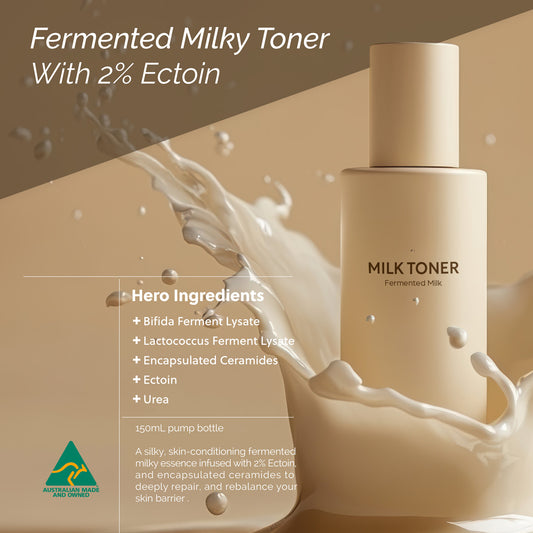
$0.00 AUDSale price$79.00 AUD Save $-79.00 AUD (%)Unit priceperFermented Milky Toner
-
Regular price$59.00 AUDRegular priceSale price$59.00 AUD Save $-59.00 AUD (%)Unit priceper
Daily Face Hydrator
-
Regular price$36.00 AUDRegular priceSale price$36.00 AUD Save $-36.00 AUD (%)Unit priceper
Gel Cleanser
-
Regular price$55.00 AUDRegular priceSale price$55.00 AUD Save $-55.00 AUD (%)Unit priceper
Milk Cleanser
-
Regular price$69.00 AUDRegular priceSale price$69.00 AUD Save $-69.00 AUD (%)Unit priceper
Water Bomb Face Cream
-
Regular price$39.00 AUDRegular priceSale price$39.00 AUD Save $-39.00 AUD (%)Unit priceper
Green Envy AHA Serum