LEITIN · Ingredient research
Epigallocatechin
Gallatyl Glucoside
Epigallocatechin gallatyl glucoside is made by linking glucose to EGCG, a green-tea compound, commonly using enzymes. Studied preparations retain antioxidant activity and reduce oxidative stress in skin-cell tests. A particular preparation also has skin-tone research, making it an interesting choice for antioxidant and brightening formulations. Its performance depends on the exact glucoside and formulation.
The evidence at a glance
EGCG glucoside strengths
Antioxidant support with a particular interest in more even-looking skin
Direct Antioxidant Activity
Retains radical-scavenging activity in laboratory tests
Supported by laboratory testing · Limited
Skin’s Own Defences
Not established
Inflammation Signals
Not established
Pigment Signals
Pigment-related gene changes, with topical studies supporting more even-looking skin
Skin-cell and human skin studies · Moderate for the studied preparation
Ratings describe the studied glucoside preparations. Empty stars mean the effect is not established. These are evidence summaries, not measurements of product performance. Evidence details and sources appear below.
The exact ingredient matters
Epigallocatechin Gallatyl Glucoside is a glucose-linked EGCG derivative. The 2024 skin research used EGCG-G1, enriched in the 4′-O-α-D-monoglucoside; other studies used different attachment positions or blends. Findings are tied to the preparation tested until the supplier specification confirms a match. Ordinary EGCG is a different ingredient.
Look closer
Explore the research
All 45 targets are included, with the evidence gaps visible alongside the findings. Open a section to read its full table.
“Not Studied” means no eligible support was identified in this review, not that an effect is absent. “Insufficient Evidence” indicates that the available finding cannot establish the target-specific effect. “Limited Evidence” describes preliminary support.
01Ingredient detailsIdentity, solubility and ingredient description
Supplier-specific manufacturing and the commercial grade still need confirmation.
Scroll sideways to see every column. Keyboard users can focus the table area and use the arrow keys. A dash means no entry was supplied in that field.
| Ingredient fact | Detail | Context |
|---|---|---|
| Antioxidant Name | Epigallocatechin Gallatyl Glucoside | Ingredient identity |
| INCI Name | EPIGALLOCATECHIN GALLATYL GLUCOSIDE | Ingredient designation; commercial blend INCI must be checked against its specification |
| Alternative Names | EGCG glucoside; Glc-EGCG; EGCG-G1 (study-specific preparation) | Synonyms do not imply interchangeability with related compounds |
| Solubility | Water Soluble | Water solubility is reported for glucosylated EGCG; confirm the supplied grade and carrier |
| Antioxidant Type | Flavonoid | Ingredient classification |
| Description | Epigallocatechin gallatyl glucoside is made by linking glucose to EGCG, a green-tea compound, commonly using enzymes. Studied preparations retain antioxidant activity and reduce oxidative stress in skin-cell tests. A particular preparation also has skin-tone research, making it an interesting choice for antioxidant and brightening formulations. Its performance depends on the exact glucoside and formulation. | Antioxidant assessment summarises the research tables below. General ingredient origin: https://pmc.ncbi.nlm.nih.gov/articles/PMC11597265/. Supplier-specific manufacturing remains unconfirmed. |
02Direct antioxidant defence10 oxidant and antioxidant targets
This section permits direct cell-free antioxidant chemistry. Such findings do not, by themselves, demonstrate a benefit in human skin.
Scroll sideways to see every column. Keyboard users can focus the table area and use the arrow keys. A dash means no entry was supplied in that field.
| Antioxidant Mechanism | Evidence Strength | Antioxidant Notes | Linked Study |
|---|---|---|---|
| Singlet Oxygen ¹O₂ | Not Studied | No suitable study was identified showing how this glucoside acts against Singlet Oxygen ¹O₂. General antioxidant results cannot answer this specific question. | — |
| Superoxide O₂•− | Insufficient Evidence | A related 3′-O-α-glucoside reduced the superoxide signal in laboratory testing using hypoxanthine/xanthine oxidase and ESR detection after 90 seconds (SC50 4.1 µM). The original PDF and table were checked. This is genuine evidence for that specific form, but it does not establish the same result for the 4′-enriched EGCG-G1 preparation or an unidentified commercial grade. https://pubmed.ncbi.nlm.nih.gov/10610125/ | — |
| Hydrogen Peroxide H₂O₂ | Insufficient Evidence | A study of related EGCG glucosides measured peroxide produced as the compounds aged in solution. That tests stability, rather than removal of added hydrogen peroxide. Direct peroxide scavenging by the requested grade remains unverified. The original results and figure description were checked: https://pmc.ncbi.nlm.nih.gov/articles/PMC6274015/ | — |
| Hydroxyl Radical •OH | Not Studied | No suitable study was identified showing how this glucoside acts against Hydroxyl Radical •OH. General antioxidant results cannot answer this specific question. | — |
| Peroxyl Radicals ROO• | Not Studied | No suitable study was identified showing how this glucoside acts against Peroxyl Radicals ROO•. General antioxidant results cannot answer this specific question. | — |
| Lipid Peroxyl Radicals LOO• | Not Studied | No suitable study was identified showing how this glucoside acts against Lipid Peroxyl Radicals LOO•. General antioxidant results cannot answer this specific question. | — |
| Peroxynitrite ONOO− | Not Studied | No suitable study was identified showing how this glucoside acts against Peroxynitrite ONOO−. General antioxidant results cannot answer this specific question. | — |
| Nitric Oxide / RNS | Not Studied | No suitable study was identified showing how this glucoside acts against Nitric Oxide / RNS. General antioxidant results cannot answer this specific question. | — |
| Lipid Peroxidation | Not Studied | No suitable study was identified showing how this glucoside acts against Lipid Peroxidation. General antioxidant results cannot answer this specific question. | — |
| Metal Chelation | Not Studied | No suitable study was identified showing how this glucoside acts against Metal Chelation. General antioxidant results cannot answer this specific question. | — |
03Skin’s own antioxidant defences14 NRF2 and endogenous-defence targets
Biological findings require skin or verified skin-derived models. The available SOD abstract does not establish an increase from Glc-EGCG.
Scroll sideways to see every column. Keyboard users can focus the table area and use the arrow keys. A dash means no entry was supplied in that field.
| NRF2 Pathway Mechanism | Effect | Evidence Strength | Mechanism / Pathway | NRF2/Endogenous Notes | Linked Study |
|---|---|---|---|---|---|
| NRF2 Activation | Not Established | Not Studied | — | No eligible skin study was identified for this glucoside’s effect on NRF2 Activation. This remains an evidence gap rather than a finding of no effect. | — |
| NRF2 Protein Expression | Not Established | Not Studied | — | No eligible skin study was identified for this glucoside’s effect on NRF2 Protein Expression. This remains an evidence gap rather than a finding of no effect. | — |
| KEAP1 Expression | Not Established | Not Studied | — | No eligible skin study was identified for this glucoside’s effect on KEAP1 Expression. This remains an evidence gap rather than a finding of no effect. | — |
| NRF2 Nuclear Translocation | Not Established | Not Studied | — | No eligible skin study was identified for this glucoside’s effect on NRF2 Nuclear Translocation. This remains an evidence gap rather than a finding of no effect. | — |
| ARE Activation | Not Established | Not Studied | — | No eligible skin study was identified for this glucoside’s effect on ARE Activation. This remains an evidence gap rather than a finding of no effect. | — |
| NRF2 Degradation | Not Established | Not Studied | — | No eligible skin study was identified for this glucoside’s effect on NRF2 Degradation. This remains an evidence gap rather than a finding of no effect. | — |
| OCTN1/SLC22A4 Uptake | Not Established | Not Studied | — | No eligible skin study was identified for this glucoside’s effect on OCTN1/SLC22A4 Uptake. This remains an evidence gap rather than a finding of no effect. | — |
| GCLC Expression | Not Established | Not Studied | — | No eligible skin study was identified for this glucoside’s effect on GCLC Expression. This remains an evidence gap rather than a finding of no effect. | — |
| GSH Levels | Not Established | Not Studied | — | No eligible skin study was identified for this glucoside’s effect on GSH Levels. This remains an evidence gap rather than a finding of no effect. | — |
| HMOX1 / HO-1 Expression | Not Established | Not Studied | — | No eligible skin study was identified for this glucoside’s effect on HMOX1 / HO-1 Expression. This remains an evidence gap rather than a finding of no effect. | — |
| NQO1 Expression | Not Established | Not Studied | — | No eligible skin study was identified for this glucoside’s effect on NQO1 Expression. This remains an evidence gap rather than a finding of no effect. | — |
| TXNRD1 Expression | Not Established | Not Studied | — | No eligible skin study was identified for this glucoside’s effect on TXNRD1 Expression. This remains an evidence gap rather than a finding of no effect. | — |
| GPX2 Expression | Not Established | Not Studied | — | No eligible skin study was identified for this glucoside’s effect on GPX2 Expression. This remains an evidence gap rather than a finding of no effect. | — |
| SOD Activity | Not Established | Insufficient Evidence | — | The 2014 study tested this protective enzyme, but its abstract assigns the increase to glucosylated caffeic acid. It does not establish an increase from Glc-EGCG. The glucoside-specific result and treatment details still need the full paper: https://pubmed.ncbi.nlm.nih.gov/25196711/ | — |
04Inflammation and skin signalling12 skin-signalling targets
The 2014 abstract offers early context. Its individual cytokine results remain unconfirmed without full-text clarification.
Scroll sideways to see every column. Keyboard users can focus the table area and use the arrow keys. A dash means no entry was supplied in that field.
| Skin Signal | Effects | Evidence Strength | Skin Signalling Notes | Linked Study |
|---|---|---|---|---|
| NF-κB | Not Established | Not Studied | No eligible skin study was identified for this glucoside’s effect on NF-κB. This remains an evidence gap rather than a finding of no effect. | — |
| AP-1 | Not Established | Not Studied | No eligible skin study was identified for this glucoside’s effect on AP-1. This remains an evidence gap rather than a finding of no effect. | — |
| COX-2 | Not Established | Not Studied | No eligible skin study was identified for this glucoside’s effect on COX-2. This remains an evidence gap rather than a finding of no effect. | — |
| iNOS | Not Established | Not Studied | No eligible skin study was identified for this glucoside’s effect on iNOS. This remains an evidence gap rather than a finding of no effect. | — |
| PGE2 | Not Established | Not Studied | No eligible skin study was identified for this glucoside’s effect on PGE2. This remains an evidence gap rather than a finding of no effect. | — |
| MMP-1 | Not Established | Not Studied | No eligible skin study was identified for this glucoside’s effect on MMP-1. This remains an evidence gap rather than a finding of no effect. | — |
| MMP-3 | Not Established | Not Studied | No eligible skin study was identified for this glucoside’s effect on MMP-3. This remains an evidence gap rather than a finding of no effect. | — |
| MMP-9 | Not Established | Not Studied | No eligible skin study was identified for this glucoside’s effect on MMP-9. This remains an evidence gap rather than a finding of no effect. | — |
| IL-1β | Not Established | Insufficient Evidence | The 2014 abstract reports lower inflammatory messenger production with glucosylated polyphenols in UV-exposed human skin-cell models. The exact Glc-EGCG result for IL-1β, dose and responding cell type could not be checked without the full paper, so this target remains unconfirmed. https://pubmed.ncbi.nlm.nih.gov/25196711/ | — |
| IL-6 | Not Established | Insufficient Evidence | The 2014 abstract reports lower inflammatory messenger production with glucosylated polyphenols in UV-exposed human skin-cell models. The exact Glc-EGCG result for IL-6, dose and responding cell type could not be checked without the full paper, so this target remains unconfirmed. https://pubmed.ncbi.nlm.nih.gov/25196711/ | — |
| IL-8 | Not Established | Insufficient Evidence | The 2014 abstract reports lower inflammatory messenger production with glucosylated polyphenols in UV-exposed human skin-cell models. The exact Glc-EGCG result for IL-8, dose and responding cell type could not be checked without the full paper, so this target remains unconfirmed. https://pubmed.ncbi.nlm.nih.gov/25196711/ | — |
| TNF-α | Not Established | Not Studied | No eligible skin study was identified for this glucoside’s effect on TNF-α. This remains an evidence gap rather than a finding of no effect. | — |
05Pigment signalling9 pigment-signalling targets
The gene-expression findings concern the studied EGCG-G1 preparation and remain preliminary. They do not establish protein effects or a benefit from every commercial glucoside grade.
Scroll sideways to see every column. Keyboard users can focus the table area and use the arrow keys. A dash means no entry was supplied in that field.
| Pigment Signal | Effects | Evidence Strength | Pigment Signalling Notes | Linked Study |
|---|---|---|---|---|
| α-MSH | Not Established | Not Studied | No eligible skin study was identified for this glucoside’s effect on α-MSH. This remains an evidence gap rather than a finding of no effect. | — |
| MC1R | ↓ Downregulated | Limited Evidence | EGCG-G1 lowered MC1R gene messages in cultured human keratinocytes and melanocytes from one donor after 24 hours at 0.01%. This is an early pigment-pathway finding, not a confirmed protein effect. | https://pubmed.ncbi.nlm.nih.gov/39598779/ |
| MITF | ↓ Downregulated | Limited Evidence | EGCG-G1 lowered MITF gene messages in cultured human keratinocytes and melanocytes from one donor after 24 hours at 0.01%. This is an early pigment-pathway finding, not a confirmed protein effect. The reported percentage is inconsistent and is omitted. | https://pubmed.ncbi.nlm.nih.gov/39598779/ |
| Tyrosinase | ↓ Downregulated | Limited Evidence | EGCG-G1 lowered TYR gene messages in cultured human keratinocytes and melanocytes from one donor after 24 hours at 0.01%. This is an early pigment-pathway finding, not a confirmed protein effect. | https://pubmed.ncbi.nlm.nih.gov/39598779/ |
| TRP-1 | ↓ Downregulated | Limited Evidence | EGCG-G1 lowered TYRP1 gene messages in cultured human keratinocytes and melanocytes from one donor after 24 hours at 0.01%. This is an early pigment-pathway finding, not a confirmed protein effect. | https://pubmed.ncbi.nlm.nih.gov/39598779/ |
| TRP-2 | Not Established | Not Studied | No eligible skin study was identified for this glucoside’s effect on TRP-2. This remains an evidence gap rather than a finding of no effect. | — |
| ET-1 | Not Established | Insufficient Evidence | The study found lower gene-message levels for the EDNRB receptor in human cells grown together. It did not measure ET-1, the signalling molecule that binds to a receptor. EDNRB and ET-1 are different targets, so this result does not establish an effect on ET-1: https://pubmed.ncbi.nlm.nih.gov/39598779/ . | — |
| SCF/c-KIT | ↓ Downregulated | Limited Evidence | EGCG-G1 lowered KIT gene messages in cultured human keratinocytes and melanocytes from one donor after 24 hours at 0.01%. This is an early pigment-pathway finding, not a confirmed protein effect. SCF itself was not measured. | https://pubmed.ncbi.nlm.nih.gov/39598779/ |
| PGE2 | Not Established | Not Studied | No eligible skin study was identified for this glucoside’s effect on PGE2. This remains an evidence gap rather than a finding of no effect. | — |
Reading the findings carefully
What the research can tell us
The 2024 paper contains molecular-weight/dilution and percentage-calculation inconsistencies. Gene direction is reported without repeating unreliable percentage reductions.
General ROS reduction and DPPH/ABTS activity are useful antioxidant findings, but they do not establish singlet-oxygen quenching or every required oxidant target. The 2024 EGCG-G1 study also included four 56-day topical placebo-controlled skin-tone trials. This supports a moderate, preparation-specific pigment summary; the individual gene findings remain preliminary. The studies belong to one publication, with formulation differences and reporting inconsistencies limiting broad comparisons. The 2014 abstract supports early anti-inflammatory context, while its individual cytokine results still require full-text confirmation.
No native-EGCG pathway finding has been substituted. Commercial grade matching remains required.
How this review was assessed
The direct antioxidant section permits direct cell-free antioxidant chemistry. All biological findings and the skin-defence, skin-signalling and pigment-signalling sections require skin or verified skin-derived models. Primary studies were compared by endpoint, attribution, model and controls. Strong chemical evidence does not imply strong skin efficacy. Not Studied means no eligible support identified in this review, not that the effect is absent. Unresolved access and methods are stated in Notes.
The 1 October update searched the glucoside name, Glc-EGCG and glucosylated EGCG with direct oxidant terms, skin and NRF2/signalling terms, and followed relevant original references. The 1999 PDF was checked visually; accessible 2024 original methods and results were rechecked. The 2014 full text remained inaccessible, so its abstract supports general context only. This is a targeted literature review rather than an exhaustive systematic review. Sources below identify the publications used to validate or limit the conclusions.
Follow the evidence
Sources
Publications used to validate or limit the conclusions. Verification notes are those recorded in the source review.
-
Boira C, Chapuis E, Lapierre L, Auriol D, Jarrin C, Robe P, Tiguemounine J, Scandolera A, Reynaud R. 2024 Epigallocatechin Gallate Enzymatic Alpha Glucosylation Potentiates Its Skin-Lightening Activity-Involvement of Skin Microbiota. Molecules (Basel, Switzerland)
https://pubmed.ncbi.nlm.nih.gov/39598779/
Role: Glucoside identity; skin ROS context; MC1R, MITF, TYR, TYRP1 and KIT gene-expression findings. Verification: Full text verified.
-
Nadim M, Auriol D, Lamerant-FayeL N, Lefèvre F, Dubanet L, Redziniak G, Kieda C, Grillon C. 2014 Improvement of polyphenol properties upon glucosylation in a UV-induced skin cell ageing model. International journal of cosmetic science
https://pubmed.ncbi.nlm.nih.gov/25196711/
Role: Earlier glucosylated-polyphenol skin study; cytokine and SOD assignment requires full-text clarification. Verification: Abstract and publisher synopsis verified.
-
Effect of α-Glucosylation on the Stability, Antioxidant Properties, Toxicity, and Neuroprotective Activity of (–)-Epigallocatechin Gallate. Frontiers in Nutrition. 2019;6:30.
https://doi.org/10.3389/fnut.2019.00030
Role: Related glucoside regioisomers: ABTS chemistry; neuronal biological experiments excluded. Verification: Publisher abstract verified.
-
Nanjo F, Mori M, Goto K, Hara Y. Radical scavenging activity of tea catechins and their related compounds. Bioscience, Biotechnology, and Biochemistry. 1999;63(9):1621–1623.
https://pubmed.ncbi.nlm.nih.gov/10610125/
https://doi.org/10.1271/bbb.63.1621
https://www.jstage.jst.go.jp/article/bbb/63/9/63_9_1621/_pdf
Original PDF methods and Table 2 visually checked. The 3′-O-α-glucoside gave a superoxide SC50 of 4.1 µM, using hypoxanthine/xanthine oxidase and ESR spin-trapping at 90 seconds. The result belongs to that attachment position, rather than establishing performance for all EGCG glucosides. Full reaction concentrations and pH are referred to earlier methods and were not independently verified. The hydroxyl-radical table tested ordinary catechins, so its EGCG result was not assigned to the glucoside.
-
Synthesis and Biological Testing of Novel Glucosylated Epigallocatechin Gallate (EGCG) Derivatives. Molecules. 2016;21:620.
https://pmc.ncbi.nlm.nih.gov/articles/PMC6274015/
https://doi.org/10.3390/molecules21050620
Original results and figure descriptions checked through indexed full-text passages. Related glucosides retained DPPH activity but were less active than ordinary EGCG in this assay. Hydrogen peroxide was measured as a stability by-product, not as a scavenging challenge. Breast-cancer-cell experiments were excluded. These synthetic derivatives have not been equated with the 2024 EGCG-G1 blend.
-
Beneficial Effects of Epigallocatechin Gallate in Preventing Skin Photoaging: A Review. Molecules. 2024;29:5226.
https://pmc.ncbi.nlm.nih.gov/articles/PMC11596539/
Used to trace the 2014 original glucoside study and distinguish it from native EGCG, tea extracts and delivery systems. It is not an independent experiment or a substitute for the unavailable glucoside-specific cytokine results.
Products for Dry & Dehydrated Skin
-
Regular price$79.00 AUDRegular price
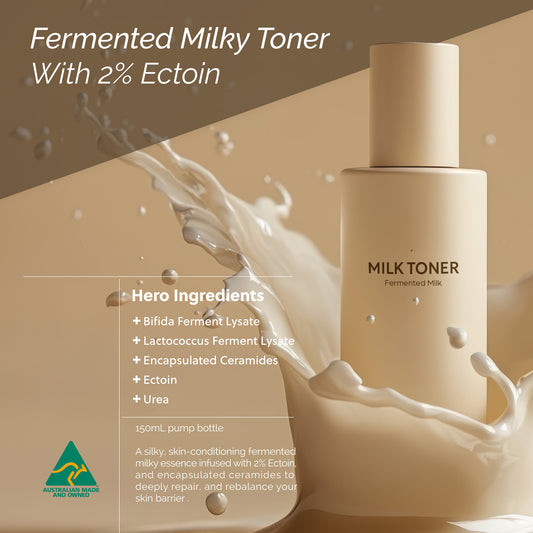
$0.00 AUDSale price$79.00 AUD Save $-79.00 AUD (%)Unit priceperFermented Milky Toner
-
Regular price$59.00 AUDRegular priceSale price$59.00 AUD Save $-59.00 AUD (%)Unit priceper
Daily Face Hydrator
-
Regular price$36.00 AUDRegular priceSale price$36.00 AUD Save $-36.00 AUD (%)Unit priceper
Gel Cleanser
-
Regular price$55.00 AUDRegular priceSale price$55.00 AUD Save $-55.00 AUD (%)Unit priceper
Milk Cleanser
-
Regular price$69.00 AUDRegular priceSale price$69.00 AUD Save $-69.00 AUD (%)Unit priceper
Water Bomb Face Cream
-
Regular price$39.00 AUDRegular priceSale price$39.00 AUD Save $-39.00 AUD (%)Unit priceper
Green Envy AHA Serum