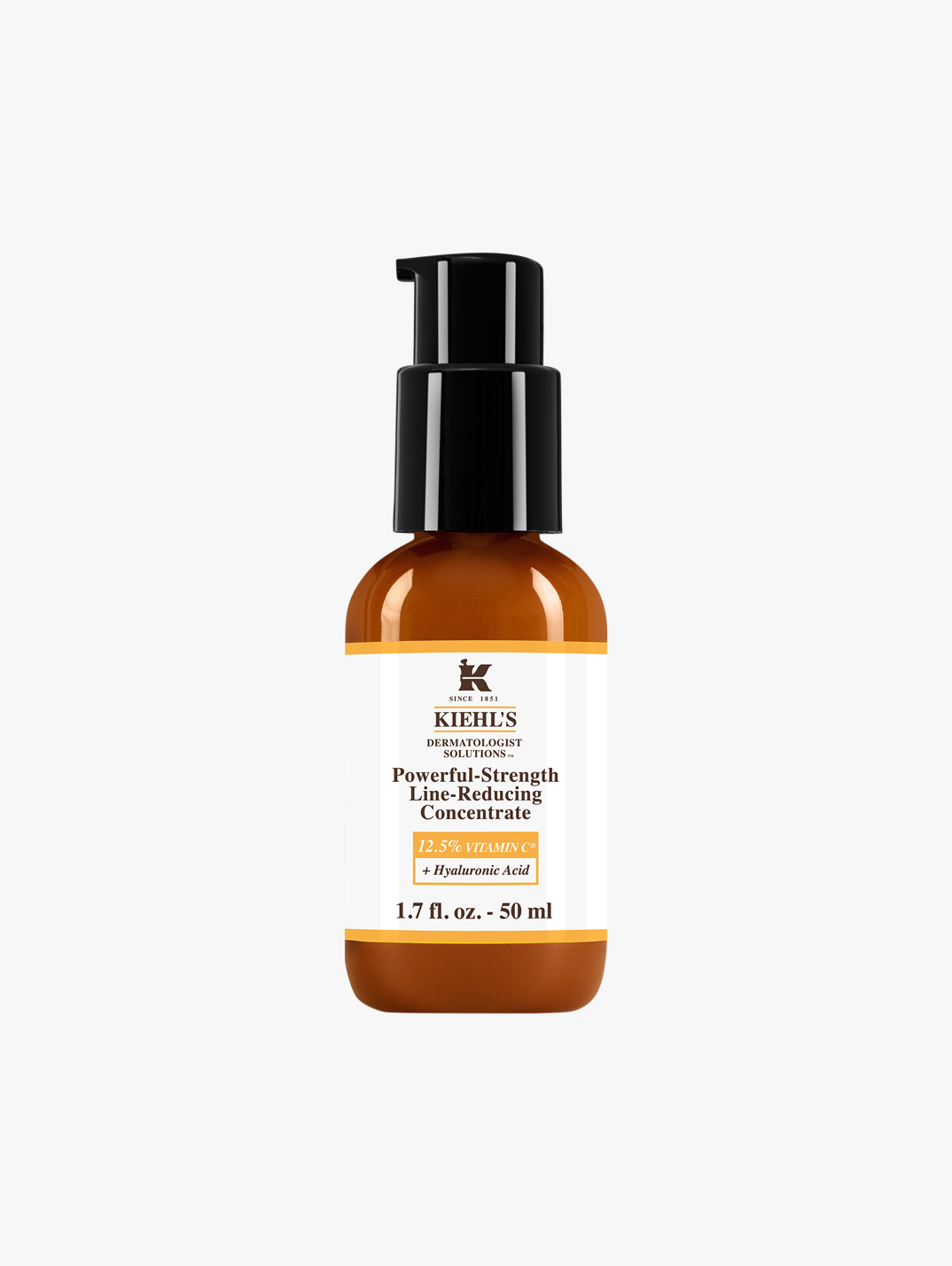
Kiehl’s Powerful-Strength Line-Reducing Concentrate pairs two vitamin C forms with adenosine and a smoothing, water-free base. We explore the ingredients, product claims and supporting research.
FORMULA NOTES / VITAMIN C SERUM
Kiehl’s
Powerful-Strength Line-Reducing Concentrate
A closer look at its two vitamin C forms, water-free smoothing base and supporting hydration ingredients.
A formulation-based review
Full ingredient list (INCI)
propylene glycol, dimethicone, glycerin, ascorbic acid, ethylhexyl palmitate, cetyl peg/ppg-10/1 dimethicone, dimethicone crosspolymer, ascorbyl glucoside, cyclohexasiloxane, hydroxyethylpiperazine ethane sulfonic acid, lauroyl lysine, acrylonitrile/methyl methacrylate/vinylidene chloride copolymer, polysilicone-11, adenosine, hydrolyzed hyaluronic acid, limonene, isobutane, citrus aurantium dulcis (orange) peel oil, citrus limon peel oil / lemon peel oil, citral, pentaerythrityl tetra-di-t-butyl hydroxyhydrocinnamate
Source: MECCA Australia’s published formula, with ingredient separators restored, checked 30 October 2026. This review concerns that listed formula. Other regional lists include a different base with boron nitride; check your own pack rather than treating the variants as identical.
The focus
Visible lines, texture & radiance
The format
50 mL · Water-free concentrate
Price snapshot
A$150MECCA listed price · checked 30 Oct 2026; online availability may vary
Worth knowing
10.5% L-ascorbic acid + 2% ascorbyl glucoside
| Product | Formulation Rating | Value Rating | Overall Rating |
|---|---|---|---|
| Kiehl’s10.5% L-ascorbic acid + 2% ascorbyl glucosideA$150.00 · 50 mL |
★★★★★Antioxidant
★★★★☆Pigment Signalling
★★★★★Hydration
|
A$30.00 per 10 mL; concentration-adjusted component uses 10.5% L-ascorbic acid. |
A vitamin C concentrate built around its vehicle
Kiehl’s pairs free ascorbic acid with ascorbyl glucoside in a water-free, silicone-rich concentrate. The formula has a clear focus on visible lines and skin texture, with glycerin, hydrolyzed hyaluronic acid and adenosine supporting the overall design.
Its character comes as much from the base as the active ingredients. Silicones, emollients and texture modifiers provide slip and a smoother surface feel, while the vitamin C system gives the product its longer-term treatment purpose. Those are complementary contributions, although an immediate smoothing effect is different from a biological change in skin structure.
Who might it suit?
- People concerned with visible lines and uneven texture: the active system and smoothing base align with those priorities.
- Those who enjoy a silicone-rich finish: the vehicle is likely to feel different from a thin, watery vitamin C serum.
- Skin needing moisture support alongside treatment: glycerin and hydrolyzed hyaluronic acid contribute water-binding functions.
Citrus oils, limonene and citral are listed, so fragrance-reactive skin may prefer another option. Concentrated ascorbic acid can also sting, particularly on an irritated barrier. Although the brand describes broad skin-type suitability, individual tolerance remains the deciding factor.
The brand directs morning and evening use on clean skin, avoiding the eye area, before moisturiser. Introduce gradually if needed and use broad-spectrum sunscreen each morning. Persistent burning or redness is a reason to stop rather than push through.
What does 12.5% vitamin C mean?
The brand specifies 10.5% L-ascorbic acid plus 2% ascorbyl glucoside. The total describes two different vitamin C ingredients. The glucoside portion is a derivative, so the full 12.5% should not be described as pure ascorbic acid or a measured amount delivered into skin.
The water-free format is also relevant. Conventional aqueous pH cannot be assigned to this undiluted concentrate in the same way as to a water-based serum. Its glycol-and-silicone base is a formulation strategy for the active ingredients and sensory finish.
Ingredients grouped by function
Ingredients are grouped by their estimated primary role in this formula; some ingredients have more than one function.
| Function | Ingredients | Role in formula |
|---|---|---|
| Function: Vitamin C and Line-Support Actives | Ingredients: ascorbic acid; ascorbyl glucoside; adenosine | Role in formula: The main vitamin C and visible-line-support system. |
| Function: Humectants | Ingredients: propylene glycol; glycerin; hydrolyzed hyaluronic acid | Role in formula: Water binding and supporting solvent functions. |
| Function: Other Emollients | Ingredients: dimethicone; ethylhexyl palmitate; cyclohexasiloxane | Role in formula: Slip, softness and a conditioned surface feel. |
| Function: Emulsifying and Dispersion Support | Ingredients: cetyl peg/ppg-10/1 dimethicone | Role in formula: Helps organise and disperse components within the vehicle. |
| Function: Texture and Film-Forming Ingredients | Ingredients: dimethicone crosspolymer; acrylonitrile/methyl methacrylate/vinylidene chloride copolymer; polysilicone-11; lauroyl lysine; isobutane | Role in formula: Structure, spread and sensory smoothing; exact supplied-material roles are estimated. |
| Function: Buffering Ingredient | Ingredients: hydroxyethylpiperazine ethane sulfonic acid | Role in formula: HEPES provides formulation buffering support; it is not an AHA. |
| Function: Aromatic Ingredients | Ingredients: limonene; citrus aurantium dulcis (orange) peel oil; citrus limon peel oil / lemon peel oil; citral | Role in formula: Citrus aroma and declared fragrance constituents. |
| Function: Formula Antioxidant | Ingredients: pentaerythrityl tetra-di-t-butyl hydroxyhydrocinnamate | Role in formula: Helps protect formulation materials from oxidation. |
The key ingredients, explained
| Ingredient | What it contributes |
|---|---|
| Ingredient: L-ascorbic acid · 10.5% | What it contributes: Free vitamin C supplies antioxidant activity and participates in collagen-related enzyme functions. Other topical formulations have been studied for photoaged skin, as outlined below. |
| Ingredient: Ascorbyl glucoside · 2% | What it contributes: A glucose-linked vitamin C derivative that complements the free vitamin C. Its conversion and delivery depend on conditions; it is not automatically assigned every clinical result reported for ascorbic acid. |
| Ingredient: Adenosine | What it contributes: Adds a line-support ingredient with controlled human formulation studies. Its concentration here is not disclosed. |
| Ingredient: Glycerin and hydrolyzed hyaluronic acid | What it contributes: Water-binding support helps the skin surface feel hydrated and look smoother. The molecular-weight distribution of the hydrolyzed material is not specified. |
| Ingredient: Silicones and ethylhexyl palmitate | What it contributes: Provide softness, glide and a smoothing finish. Elastomeric texture ingredients contribute to the distinctive feel of the concentrate. |
Vitamin C treatment with a smoothing, water-free base
The vehicle is a central part of this formulation. Glycols and glycerin support the polar portion of the concentrate, while silicones and the ester emollient help it spread and soften the surface. Water-free does not mean that a product cannot support hydration: humectants interact with moisture at the skin surface.
Adenosine and hydrolyzed hyaluronic acid add useful supporting roles without turning the formula into a peptide treatment. Lauroyl lysine is an amino-acid-derived texture ingredient, not a collagen-signalling peptide. This is a focused vitamin C concentrate with a deliberate sensory design.
Reading the claims carefully
Kiehl’s describes visible line improvement and results from two weeks, while MECCA refers to clinical improvements in texture, tone and radiance. The public summaries reviewed do not provide a full protocol, comparator or numerical effect sizes for this exact Australian-listed formula.
Those claims are best read as brand-reported finished-product results. The independent ingredient studies below explain the formulation rationale; they do not validate every timing, penetration or persistence claim for this concentrate.
What ingredient research tells us
These studies evaluated other formulations, not this Kiehl’s concentrate.
Vitamin C and photoaged skin
A randomised, double-blind trial compared a 5% vitamin C cream with its vehicle over six months on photoaged neck and arm skin. Clinical assessment and skin-surface measurements favoured vitamin C, including improvements in deep furrows. This supports the role of topical ascorbic acid, but does not predict the size of the effect from a different concentration or vehicle. Humbert and colleagues, 2003.
Adenosine and facial lines
A blinded, randomised, placebo-controlled study involved 126 women aged 45–65 and compared adenosine-containing cream or dissolvable film with placebo. Optical skin measurements showed improvements in periorbital smoothness after three weeks and at two months; the cream also improved glabellar lines. This supports an adenosine formulation role, without establishing the effect of the undisclosed dose used here. Abella, 2006.
Our assessment
Kiehl’s combines 10.5% L-ascorbic acid with 2% ascorbyl glucoside, adenosine and hydration support in a water-free, silicone-rich base. Its 12.5% total vitamin C claim is not a pure-ascorbic-acid percentage. This serum earns an Overall Rating of 3.75 stars in our comparison of 15 ascorbic acid vitamin C serums.
At the comparison snapshot price of A$150 for 50 mL (1 November 2026), the cost is A$30.00 per 10 mL. The larger bottle offers a relatively economical volume-normalised price within this comparison. Value uses its disclosed 10.5% L-ascorbic acid concentration, not the combined 12.5% vitamin C claim; the smoothing vehicle and consistent use remain relevant to the purchase.
The smoothing silicone-rich texture and adenosine support add a reason to choose it beyond price alone. It is a competitive option when that finish suits your routine and you expect to use the larger bottle consistently. Citrus aromatic ingredients remain a consideration for fragrance-reactive skin.
Further reading
Products for Dry & Dehydrated Skin
-
Regular price$79.00 AUDRegular price
$0.00 AUDSale price$79.00 AUD Save $-79.00 AUD (%)Unit priceperFermented Milky Toner
-
Regular price$59.00 AUDRegular priceSale price$59.00 AUD Save $-59.00 AUD (%)Unit priceper
Daily Face Hydrator
-
Regular price$36.00 AUDRegular priceSale price$36.00 AUD Save $-36.00 AUD (%)Unit priceper
Gel Cleanser
-
Regular price$55.00 AUDRegular priceSale price$55.00 AUD Save $-55.00 AUD (%)Unit priceper
Milk Cleanser
-
Regular price$69.00 AUDRegular priceSale price$69.00 AUD Save $-69.00 AUD (%)Unit priceper
Water Bomb Face Cream
-
Regular price$39.00 AUDRegular priceSale price$39.00 AUD Save $-39.00 AUD (%)Unit priceper
Green Envy AHA Serum